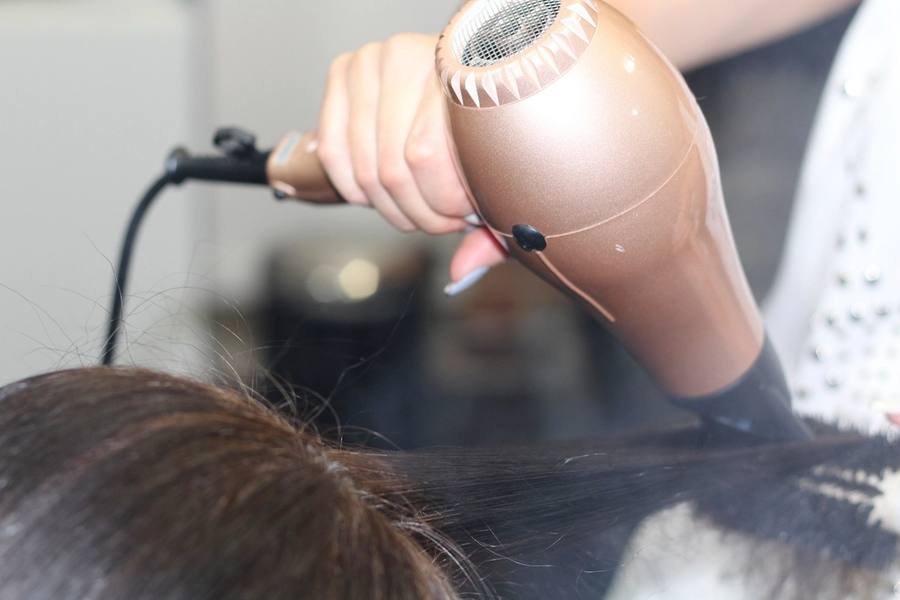
Symbolbild (Stockfoto); nicht das abgebildete Produkt.
One Action Instead Of Two
A conventional blow-dry means holding a dryer in one hand and a round brush in the other, coordinating both, which takes practice most people never get.
A hot air brush combines them, so one hand does the work and the brush is always aligned with the airflow.
That makes a reasonable blow-dry achievable by somebody who cannot do one with separate tools, which is the main reason these became popular.
Less Heat Than Two Stages
Drying with a dryer and then styling with a straightener or curling iron means two separate heat exposures on the same hair.
A hot air brush does both in one pass at a lower temperature than a styling iron uses, which means meaningfully less cumulative heat damage.
That is a genuine benefit rather than a marketing point, and it is the strongest argument for the category for anybody styling frequently.
It Needs Damp, Not Wet Hair
These work on hair that is around eighty percent dry rather than soaking, and using one on wet hair is slow and gives poor results.
Rough-drying with a normal dryer first, then finishing with the brush, is the standard approach and is faster than using the brush throughout.
Hair that is completely dry also styles poorly with one, since the shaping relies on the remaining moisture setting as it dries.
Barrel Size And Hair Length
Large barrels produce volume and smooth waves and are unwieldy on short hair, where small barrels suit shorter styles and fringes.
Very long thick hair takes a long time with a small barrel, and an oval or paddle shape suits smoothing where a round barrel suits volume and curl.
Matching the shape and size to your hair and intended style is what determines the result, more than airflow or heat specifications do.
Heat settings on these tools are generally more limited than on a dedicated dryer, and some offer only a single temperature, which for fine or damaged hair is a genuine drawback. A model with at least two heat settings plus a cool option gives enough control to avoid using more heat than the hair needs, and the cool setting at the end of each section helps the style hold in the same way it does with a conventional dryer.
Bristles, Tangles And Care
Mixed bristle designs grip hair enough to create tension without tangling, and tangling is the commonest complaint with these tools.
Working in small sections and not over-rotating the brush prevents hair wrapping around the barrel, which at worst requires cutting hair free.
The vents clog with hair and lint like any dryer, and cleaning them regularly keeps airflow up and prevents the motor overheating.
Rotating barrel versions exist and divide opinion sharply, because the barrel turns under power so the hair wraps itself rather than requiring you to rotate your wrist. For anybody who struggles with the wrist movement that is genuinely easier, and it also introduces a powered mechanism that can tangle hair far more enthusiastically than a static barrel. Most people find a static brush easier to control once the technique is learned.
The Verdict
A genuinely useful tool that makes a decent blow-dry achievable one-handed and reduces total heat exposure compared to drying then styling.
It needs hair at the right dampness, barrel size must suit hair length, and tangling is a real risk with poor technique.
Rough-dry to about eighty percent first. Using it on soaking hair is slow and gives poor results, which is the usual disappointment.
Auf einen Blick
Vorteile
- Combines drying and styling into one action
- Achievable one-handed, unlike dryer plus round brush
- Less cumulative heat than drying then styling separately
- Adds volume that a dryer alone does not
Nachteile
- Needs hair around eighty percent dry, not wet
- Tangling risk with over-rotation or large sections
- Barrel size must match hair length
- Slow on very long thick hair
Häufig gestellte Fragen
Can I use it on wet hair?
It works best on hair around eighty percent dry. On soaking hair it is slow and gives poor results, which is the usual disappointment. Rough-dry with a normal dryer first, then finish with the brush.
Is it less damaging?
Compared to drying with a dryer and then styling with a straightener, yes — that is two separate heat exposures, where this does both in one pass at a lower temperature than a styling iron uses.
Why does my hair tangle in it?
Sections too large or over-rotating the brush, which wraps hair around the barrel. Work in small sections and rotate less than feels natural. At worst, badly wrapped hair has to be cut free.
Spezifikationen
| Type | Combined hot air styling brush |
| Hair state | Around eighty percent dry |
| Heat exposure | Lower than dryer plus styling iron |
| Large barrel | Volume and waves, longer hair |
| Small barrel | Short hair and fringes |
| Technique | Small sections; avoid over-rotating |
| Common problem | Hair tangling around the barrel |
| Maintenance | Clean vents regularly |
Fazit
Makes a decent blow-dry achievable one-handed with less total heat. Rough-dry to eighty percent first.
Preis auf Amazon prüfen